Skip to main content


Contact
(877) 68-CALLJIMjimfreeman05@gmail.com19 N Yonge Street #75
Ormond Beach, FL 3217424/7 Emergency Service Available
Contact Us Online© 2024-2026 JF Roadside Services. All rights reserved.
Powered by Dolooma
© 2024-2026 JF Roadside Services. All rights reserved.
Powered by Dolooma

Ran Out of Gas on I-95, US-1, or Anywhere in Volusia County? We Bring Fuel Directly to Your Vehicle
Running out of gas is frustrating and stressful—especially when you're stranded on a busy highway, stuck in a remote area, or dealing with Florida heat. JF Roadside Service eliminates the hassle. We're a locally owned, Ormond Beach-based roadside assistance provider that delivers emergency fuel to drivers throughout Volusia County and Flagler County, 24 hours a day, every day of the year. Whether you're out of gas on Interstate 95 near the Granada Boulevard exit, stranded on Ridgewood Avenue in downtown Ormond Beach, stuck on State Road 40 heading toward the Ocala National Forest, or broken down on a residential street in Port Orange, we dispatch a professional technician with fuel to your exact location—usually within 30 to 45 minutes. No walking to a gas station in dangerous traffic. No waiting hours for a national call center to find a contractor. Just call (877) 68-CALLJIM, tell us where you are, and we'll handle the rest so you can get back on the road quickly and safely.
When you run out of gas in Volusia County, you have options: you can call a national roadside assistance hotline that routes your call to a call center in another state, or you can call JF Roadside Service—a locally owned business based right here in Ormond Beach. We're not a franchise. We're not a referral network. We're a family-owned company with technicians who live in the same communities we serve, drive the same roads every day, and understand exactly where you are when you call for help. That local knowledge translates into faster response times, better communication, and a level of personal service that national chains simply cannot match. Our owner, Jim Freeman, has built this business on the principle that roadside emergencies deserve urgent, professional, courteous responses—not automated phone menus, long hold times, or vague arrival windows. When you call us, you speak to a real person in our Ormond Beach office who knows the area, dispatches the closest available technician immediately, and keeps you informed until help arrives.
Our fuel delivery technicians are strategically positioned throughout Ormond Beach, Daytona Beach, Port Orange, New Smyrna Beach, and Palm Coast. When you call, we dispatch the nearest available technician immediately—no waiting for a contractor to accept the job, no delays while a national company tries to find someone in your area. Most of our customers see arrival times of 30-45 minutes from the moment they call, even during peak traffic hours. If you're in a high-priority situation (stranded with children in extreme heat, disabled in a dangerous highway location, or facing an urgent appointment), tell our dispatcher and we'll do everything possible to expedite your service.
Running out of gas doesn't follow a convenient schedule. It happens at 2 AM on Sunday mornings when you're driving home from a late event. It happens on Christmas Day when you're visiting family and misjudge your fuel range. It happens during afternoon thunderstorms, during bike week traffic jams, and during spring break beach congestion. JF Roadside Service operates around the clock with live dispatchers and on-call technicians ready to respond at any hour, including nights, weekends, and all major holidays. We don't use answering services or voicemail—when you call (877) 68-CALLJIM, a real person answers, takes your information, and dispatches help immediately. Our technicians work dedicated night and early-morning shifts specifically to serve drivers who need help during off-peak hours when many other services are closed or understaffed.
Before we dispatch a technician to deliver fuel, our dispatcher provides a clear, itemized quote: a base service fee for the emergency delivery plus the actual cost of the fuel we bring (typically 2 gallons of regular unleaded gasoline, enough to drive 40-60 miles to the nearest gas station). That quote is final. We don't add surcharges for after-hours service, highway locations, weekend calls, or holiday responses. We don't inflate fuel prices beyond what we pay at the pump. The price we quote over the phone is the price you pay when the technician arrives. We accept cash, all major credit cards, debit cards, and mobile payment options like Apple Pay and Google Pay. You'll receive a detailed receipt for your records, and if your auto insurance or motor club offers fuel delivery reimbursement, we provide the documentation you need to file a claim.
Every JF Roadside Service fuel delivery technician is trained in safe on-site fueling procedures, customer service, and roadside safety protocols. They arrive in clearly marked company vehicles (so you know it's us, not an unmarked contractor), wear professional uniforms with name badges, and carry commercial-grade DOT-approved fuel containers that meet all federal and Florida state safety standards. Our technicians understand that running out of gas is stressful and sometimes embarrassing, and they treat every customer with respect, patience, and courtesy regardless of the circumstances. They'll introduce themselves by name, explain what they're doing as they add fuel to your tank, verify that your vehicle starts and runs properly before leaving, and provide directions to the nearest gas station if you're unfamiliar with the area. If they notice any signs of a fuel leak, a failing fuel pump, or other mechanical issues that caused you to run out, they'll let you know and can arrange a tow to a trusted repair shop if necessary.
If your vehicle runs out of gas anywhere in Ormond Beach, Daytona Beach, Port Orange, New Smyrna Beach, Edgewater, Palm Coast, Flagler Beach, or the surrounding areas of Volusia County and Flagler County, here's exactly what happens when you call JF Roadside Service for emergency fuel delivery. **Step 1: Call (877) 68-CALLJIM and Speak to a Live Dispatcher** — When you call our main line, a live dispatcher in our Ormond Beach office answers immediately (no automated phone trees, no long hold times). The dispatcher will ask for key information: your exact location (use GPS coordinates from your phone, mile markers if you're on a highway, nearby cross streets, or recognizable landmarks like shopping centers or parks), what type of fuel your vehicle requires (regular unleaded gasoline is standard for most passenger cars and SUVs; mention if you need diesel fuel or premium gasoline), your vehicle's make, model, and color (so the technician can identify you quickly), and a callback phone number in case the technician needs directions or has trouble locating you. If you're in a particularly urgent or unsafe situation—stranded on a high-speed highway shoulder, stuck in extreme heat with young children or elderly passengers, or in an area where you feel unsafe—tell the dispatcher immediately so we can prioritize your call and potentially coordinate with law enforcement for additional safety. **Step 2: We Dispatch the Nearest Available Technician** — As soon as we have your information, we dispatch the closest JF Roadside Service technician to your location. Our technicians carry multiple fuel containers in their service vehicles and are equipped to deliver regular unleaded gasoline immediately. If you need diesel fuel or premium gasoline, we may need a few extra minutes to source the specific fuel type, but we'll let you know the expected delay when you call. Our dispatcher will give you an estimated arrival time based on your location, current traffic conditions, and the technician's current position. Most arrivals in Ormond Beach, Daytona Beach, and Port Orange occur within 30-45 minutes; more remote locations in western Volusia County or northern Flagler County may take slightly longer depending on distance and road conditions. **Step 3: The Technician Arrives and Safely Adds Fuel to Your Tank** — When the technician reaches your location, they'll park safely behind or near your vehicle (using hazard lights and safety cones if you're on a highway), approach your vehicle, introduce themselves, and confirm that you called for fuel delivery. They'll then use a DOT-approved fuel container to add gasoline to your tank—typically 2 gallons, which is sufficient to drive 40-60 miles depending on your vehicle's fuel economy. If you request additional fuel (for peace of mind or if the nearest gas station is unusually far), the technician can provide more gallons for an additional cost. The fueling process takes only a few minutes and follows strict safety protocols to prevent spills, fumes, and fire hazards. **Step 4: We Verify Your Vehicle Starts and You're Ready to Drive** — After adding fuel, the technician will ask you to start your vehicle to confirm it's running properly. In most cases, the engine will start immediately and you'll be ready to drive to the nearest gas station. If your vehicle doesn't start after adding fuel, the problem may be more serious than an empty tank—possible issues include a failed fuel pump (which can burn out when run completely dry), air trapped in the fuel lines (especially common in diesel engines), a dead battery (from repeated cranking attempts), or an unrelated mechanical failure. The technician will perform basic troubleshooting and can often provide a jump start on the spot if your battery is simply drained. If the vehicle still won't start, we can arrange a tow to a nearby repair shop so a mechanic can diagnose and fix the underlying problem. **Step 5: Get Directions and Drive to the Nearest Gas Station** — Once your vehicle is running, the technician will provide directions to the closest gas station (which they know from local experience, not just GPS). They'll recommend filling your tank completely rather than adding just a few gallons, since repeatedly running low on fuel can damage your fuel pump over time. They'll also remind you to watch your fuel gauge closely over the next few days—if it drops faster than normal, you may have a fuel leak or a gauge malfunction that needs professional attention. After you're safely on your way, the technician completes the service call, processes payment if you haven't paid already, and provides a receipt for your records.
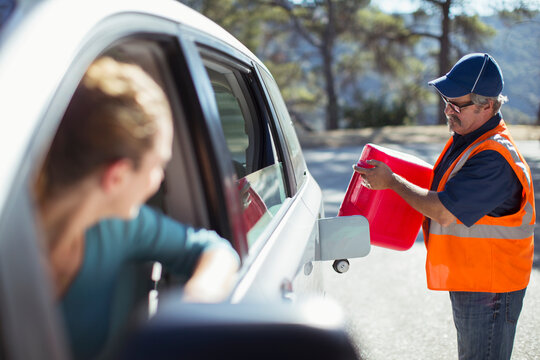
Delivery of 2 gallons of fuel (regular unleaded gasoline standard; diesel or premium available upon request) directly to your vehicle wherever you are stranded
Immediate dispatch to your exact location anywhere in our service area, with typical arrival times of 30-45 minutes from the moment you call
Safe, professional on-site fueling using DOT-approved commercial fuel containers and strict safety procedures to prevent spills and hazards
Service available on all highways (I-95, US-1, SR-40, SR-44, A1A), residential streets, commercial parking lots, beach access roads, and rural routes throughout Volusia and Flagler County
Verification that your vehicle starts and runs properly before the technician leaves, with basic troubleshooting if the engine won't start after adding fuel
Multiple payment options including cash, all major credit cards (Visa, Mastercard, Discover, American Express), debit cards, and mobile payments (Apple Pay, Google Pay)
Clear directions to the nearest gas station from your current location, provided by technicians who know every station in the area from years of local experience
Detailed service receipt for insurance claims, reimbursement requests, or personal records, including itemized charges for service fee and fuel cost
Emergency fuel delivery is one of the most frequent roadside assistance calls we handle at JF Roadside Service—not because drivers in Volusia County are careless, but because a combination of factors unique to Florida driving makes running out of gas more common than most people realize. Understanding these factors helps you avoid becoming stranded and reminds you that if it happens to you, you're not alone. **Faulty or Inaccurate Fuel Gauges Lead to Unexpected Empty Tanks** — Fuel sending units (the sensors that tell your dashboard gauge how much fuel is in the tank) are notoriously unreliable, especially in vehicles with over 100,000 miles. Over time, these sensors corrode, drift out of calibration, or fail entirely, causing your gauge to display inaccurate readings. You might think you have a quarter tank remaining when in reality you're running on fumes. This is especially common in older pickup trucks, SUVs, and vans from the 1990s and early 2000s. Some vehicles also have fuel gauges that drop slowly until they hit the quarter-tank mark, then plummet rapidly to empty, catching drivers off guard. If your fuel gauge has ever behaved inconsistently—staying on full longer than expected, dropping suddenly, or bouncing erratically—you likely have a failing sending unit. Until you get it repaired, treat the gauge as unreliable and refuel more frequently than you think necessary. Additionally, many drivers don't realize that the low fuel warning light (the little gas pump icon that illuminates on your dashboard) typically activates when you have only 1-2 gallons remaining. In a vehicle that gets 25 miles per gallon, that's 25-50 miles of range—which sounds like a lot until you factor in Daytona Beach traffic during bike week, construction delays on Interstate 95, or detours that add unexpected miles to your trip. **Unfamiliarity With Volusia County and Flagler County Road Networks** — Tourists, snowbirds, and even new residents frequently underestimate the distances between gas stations in certain parts of Volusia County and Flagler County. While Interstate 95 has regular service plazas and exits with fuel stations, some stretches—particularly between Ormond Beach and Palm Coast or between New Smyrna Beach and the Brevard County line—have fewer exits than drivers from more densely populated states expect. State Road 40 heading west from Ormond Beach toward the Ocala National Forest is another example: after you pass the last gas stations on the western edge of Ormond Beach near Interstate 95, the next reliable fuel stop is more than 20 miles away near Barberville, and beyond that you're entering deep forest with very limited services. Beach visitors also frequently misjudge distances when driving beachside on A1A—what looks like a short drive from Flagler Beach to Daytona Beach Shores is actually over 20 miles, and there are stretches with no gas stations at all. Drivers coming from out of state for spring break, Daytona 500 race week, or Bike Week often burn more fuel than expected sitting in slow beach traffic, idling in parking lot backups, and running air conditioning continuously in Florida heat. By the time they realize their tank is low, they're far from familiar gas stations and unsure where to refuel. **The 'I Can Make It' Gamble That Backfires** — This is the single most common reason people run out of gas, and it happens to experienced drivers just as often as new drivers. You see the low fuel warning light come on while you're running late for work, so you decide to skip the gas station and fill up on your lunch break—but you get stuck in an unexpected traffic jam and run out two miles from the office. Or you're driving home exhausted after a long day in Daytona Beach and convince yourself you have just enough fuel to make it to Ormond Beach, only to run out on the Granada Boulevard bridge. Or you're heading to Port Orange from New Smyrna Beach on a Sunday evening, the gas stations near your house are always open so you'll just fill up tomorrow morning—except you forget until you're already on the road Monday and your tank is empty. The 'I can make it' gamble is especially dangerous when you're driving in areas you don't know well. If you're a tourist staying in Ormond Beach and decide to drive to St. Augustine for the day, you might think you have enough fuel to make the round trip—but if you hit traffic, take a wrong turn, or spend longer than planned sightseeing, you could run out on the drive back through rural parts of Flagler County or St. Johns County where gas stations are sparse. **Fuel Leaks and Mechanical Problems Cause Sudden Fuel Loss** — Sometimes running out of gas isn't a driver error—it's a mechanical failure. A small leak in the fuel line, a cracked fuel tank (which can happen if you hit road debris or a curb too hard), a loose or missing gas cap (which allows fuel to evaporate, especially in Florida heat), or a failing fuel pressure regulator can cause your tank to drain far faster than normal. If you filled up recently—say, within the last 50 miles—and your fuel gauge has already dropped noticeably, you likely have a leak. In these cases, adding fuel will get you to the nearest repair shop, but it won't solve the underlying problem. Our technicians can visually inspect for obvious leaks when they arrive, and if they spot fuel dripping from your vehicle, they'll advise you to have it towed to a mechanic rather than driving further and risking a fire hazard or complete fuel loss. **Long Commutes and Fluctuating Fuel Economy** — Many residents of Volusia County and Flagler County commute long distances for work: from Palm Coast to Daytona Beach (40 miles round trip), from Ormond Beach to Orlando (120+ miles round trip), from New Smyrna Beach to Port Orange (30+ miles round trip). If you're used to refueling every 300 miles based on your typical driving, but then you hit heavier-than-usual traffic, carry extra passengers or cargo, tow a trailer, or drive more aggressively (rapid acceleration and braking), your fuel economy drops and you may run out before reaching your usual fill-up point. Summer heat also affects fuel economy—running your air conditioning at maximum settings in stop-and-go traffic can reduce fuel efficiency by 10-20%, meaning a tank that normally lasts 300 miles might only last 250 miles. Couple that with a commute detour due to construction or an accident, and you can easily run out earlier than expected.
Our dispatchers and technicians don't rely solely on GPS navigation—they live and work in Ormond Beach, Daytona Beach, Port Orange, New Smyrna Beach, Edgewater, and Palm Coast. They know which highways are congested at which times of day, which residential neighborhoods have confusing street layouts, which beach access roads are one-way or restricted during events, and which rural routes have poor cell reception. When you call a national roadside assistance hotline, your call goes to a centralized call center (often in another state) that dispatches the nearest contractor they can find—someone who may not be familiar with your specific area and who has to rely entirely on GPS, which doesn't account for local traffic patterns, construction zones, or seasonal road closures. Our local knowledge translates directly into faster arrival times, fewer missed turns, and less frustration for you.
Running out of gas is stressful and sometimes embarrassing. You might feel foolish for not refueling sooner, anxious about being stranded in an unfamiliar area, or worried about the cost of emergency service. Our technicians understand these feelings because they've been in the same situation themselves or have helped family members and neighbors through it. They arrive at your location with professionalism, courtesy, and empathy. They don't make you feel judged or rushed. They introduce themselves by name, explain what they're doing and how long it will take, answer your questions patiently, and treat you the way they'd want their own family members treated if they were stranded. This personal touch is something you won't get from a contractor dispatched by a national company who views your call as just another low-paying job on a busy day.
When you call JF Roadside Service, our dispatcher provides an upfront, itemized quote before dispatching a technician: a base service fee for the emergency fuel delivery plus the actual cost of the fuel itself (based on current gas prices). That quote is what you'll pay—no add-ons, no surcharges for nights, weekends, holidays, highway locations, or urgent requests. We don't inflate fuel prices to pad our profit. We don't tack on hidden fees when the technician arrives. The price we quote over the phone is the final price, and we provide a detailed receipt that breaks down every charge. Compare that to some national roadside assistance companies that quote a base price but then add fees for after-hours service, remote locations, or expedited dispatch—fees you only discover when the bill arrives. With JF Roadside Service, what you're quoted is what you pay, guaranteed.
National roadside assistance companies operate as referral networks: when you call, they forward your request to contracted towing companies or independent roadside providers in your area. Those contractors are paid per job and prioritize higher-paying services like tows and vehicle recoveries over lower-paying services like fuel delivery. You become a low-priority call, and your wait time reflects that. JF Roadside Service is different. Roadside assistance is our core business—not an afterthought or side service. Fuel delivery, jump starts, tire changes, and lockouts are what we specialize in, and we dispatch our own employees (not contractors) who are paid to prioritize your call the moment it comes in. When you call us, your request goes directly to a dispatcher in our Ormond Beach office who immediately radios the nearest available technician. There's no middleman, no waiting for a contractor to accept or decline your job, no uncertainty about when help will arrive. We give you a realistic arrival window and stick to it.
JF Roadside Service provides emergency fuel delivery to drivers stranded anywhere in Volusia County and Flagler County, Florida. Our service area includes all major cities, towns, highways, residential neighborhoods, commercial zones, beach access roads, and rural routes. Here's a detailed breakdown of the locations where we deliver fuel most frequently. **Ormond Beach** — As our home base, Ormond Beach receives the fastest response times for emergency fuel delivery. We serve every part of the city: Granada Boulevard (State Road 40) from Interstate 95 east to the beach, Ridgewood Avenue (US Highway 1) through the downtown corridor, John Anderson Drive along the beachside peninsula, North Beach Street, South Beach Street, Tomoka Farms Road in the northwestern part of the city, Hull Road, Hand Avenue, and all residential subdivisions including Plantation Bay, Oceanside, Breakaway Trails, and Hunter's Ridge. We frequently respond to fuel delivery calls at the Interstate 95 and State Road 40 interchange (Exit 268), where drivers exiting the highway realize they're too low on fuel to continue; along US-1 near the Walmart and Lowe's shopping areas; on beachside roads near Andy Romano Beachfront Park where tourists run out after long beach days; and on Tomoka State Park access roads where visitors misjudge the distance from the park entrance back to the nearest gas station. **Daytona Beach** — We provide full coverage throughout Daytona Beach including the entire beachside area along Atlantic Avenue (State Road A1A), the mainland west of the Halifax River, and all points in between. Frequent fuel delivery zones include Interstate 95 between mile marker 256 (near the Volusia-Brevard County line) and mile marker 268 (Ormond Beach border), where drivers run out during long-distance trips between Orlando, Jacksonville, or South Florida; International Speedway Boulevard (US Highway 92) from I-95 east to the beach, especially during Daytona 500 race weeks and Bike Week when traffic congestion causes vehicles to burn more fuel than expected; the Daytona International Speedway area where event attendees often arrive on low fuel and can't find open stations near the track; Atlantic Avenue and beachside neighborhoods from Main Street Pier south to Ponce Inlet, where tourists unfamiliar with beachside geography underestimate distances; LPGA Boulevard (State Road 600) between I-95 and the beach; and residential areas west of I-95 near Daytona Beach International Airport. We also serve drivers stranded on the Dunlawton Avenue causeway connecting the mainland to beachside areas, a common breakdown location due to the lack of nearby gas stations on the bridge itself. **Port Orange** — Our fuel delivery service covers all of Port Orange including major corridors like Dunlawton Avenue (State Road 421) from I-95 east to the beach, Taylor Road, Clyde Morris Boulevard (US-1) through the city center, Williamson Boulevard (State Road 415) heading south toward Lake George and the St. Johns River, and Nova Road (State Road 5A). We frequently deliver fuel in the Spruce Creek residential area (one of the largest fly-in communities in the United States, where residents sometimes run out driving from their homes to the nearest gas station on US-1), the Port Orange Pavilion shopping area on Dunlawton Avenue, along SR-415 south of the city where drivers heading toward the Econlockhatchee River and Osteen realize they've gone too far without refueling, and on residential streets in Cypress Head, Harbour Village, Sugar Mill, and other Port Orange subdivisions. The intersection of Dunlawton Avenue and Interstate 95 (Exit 249) is a hotspot for fuel delivery calls, particularly from drivers who exit the highway thinking they'll refuel immediately but then can't find an open station late at night. **New Smyrna Beach** — We deliver fuel throughout New Smyrna Beach on both the mainland and the beachside peninsula. Key areas include State Road 44 (Canal Street) running east-west from I-95 to the beach, State Road A1A (Flagler Avenue on the beachside, Atlantic Avenue heading south), US Highway 1 through mainland New Smyrna Beach, and beachside neighborhoods south of the Flagler Avenue downtown area extending toward the Canaveral National Seashore entrance. We frequently respond to calls on the State Road 44 causeway (the North Causeway) connecting the mainland to the beach, where drivers run out after spending all day at the beach and forgetting to refuel before crossing back to the mainland; along Flagler Avenue and beachside streets where tourists park for hours and don't realize how far they are from the nearest gas station; on US-1 near the Canal Street intersection; and on State Road A1A south of New Smyrna Beach heading toward Edgewater and the national seashore, where drivers misjudge the long stretches without services. **Edgewater** — We provide fuel delivery throughout Edgewater including US Highway 1, State Road 442 (10th Street), Riverside Drive along the Indian River, and residential neighborhoods. Drivers most commonly run out of gas on US-1 heading south from New Smyrna Beach or north from Oak Hill, on SR-442 heading west toward I-95, and on roads near the northern entrance to Canaveral National Seashore, where many drivers don't realize they're entering a large protected area with no services for many miles. **Palm Coast** — Our service area includes all of Palm Coast, one of the fastest-growing cities in Florida with an extensive network of residential sections identified by letter (C-Section, F-Section, P-Section, R-Section, etc.). We deliver fuel along major routes including Palm Coast Parkway (State Road 100) from I-95 east to the beach, Old Kings Road running north-south through the western part of the city, Belle Terre Parkway running north-south through the central areas, Colbert Lane, Seminole Woods Boulevard, and the hundreds of residential streets throughout the city's sections. We frequently respond to Interstate 95 calls between mile markers 284 (SR-100 interchange) and 293 (the northern Palm Coast exits), on SR-100 heading east toward Flagler Beach or west toward Bunnell and rural Flagler County, and in residential neighborhoods where drivers run out during local errands or commutes. Palm Coast's sprawling layout and long distances between commercial areas and residential sections mean drivers often underestimate how far they're traveling within the city limits. **Flagler Beach** — We serve all of Flagler Beach including the beachside downtown area along State Road A1A, Moody Boulevard (State Road 100) heading west from the beach toward I-95, and beachside neighborhoods. Common fuel delivery locations include A1A heading north toward Marineland and St. Augustine or south toward Ormond Beach, SR-100 heading west where drivers run out before reaching I-95, and beachside parking areas where tourists spend the day and forget they're running low on fuel. **Rural and Highway Areas** — In addition to cities and towns, we deliver fuel on rural highways and backroads throughout our service territory. This includes Interstate 95 from roughly mile marker 240 (near the Brevard County line) north to mile marker 300+ (approaching St. Johns County), US Highway 1 throughout Volusia and Flagler County, State Road 40 from Ormond Beach west past Barberville toward the Ocala National Forest, State Road 44 from New Smyrna Beach west toward DeLand and Deland, Old Dixie Highway, Pioneer Trail, and various county roads in western Volusia County where gas stations are few and far between. Rural fuel deliveries sometimes take longer to reach due to distance and lower population density, but we serve these areas just as reliably as urban zones.
Running out of gas while driving can be frightening, especially if it happens on a busy highway like Interstate 95, on a high-speed road like US-1, or in a remote area where you feel vulnerable. Follow these step-by-step safety instructions to protect yourself, your passengers, and other drivers until JF Roadside Service arrives with fuel. **Step 1: Recognize the Warning Signs and Pull Over Immediately** — Your vehicle will usually give you warning signs before it completely runs out of gas. The engine may sputter, hesitate, or lose power. You may notice the RPM gauge fluctuating even though you're pressing the accelerator steadily. Some vehicles will briefly regain power and then lose it again as the fuel pump draws the last drops from the tank. The moment you notice these symptoms, turn on your hazard lights (the button with the red triangle) and look for the safest place to pull over. On a multi-lane highway like I-95, move into the right lane and aim for the paved shoulder—get as far right as possible without going onto grass, gravel, or sand where your tires could sink. On a two-lane road, pull onto the shoulder if there is one, or into a driveway, parking lot, or wide spot where you're out of the travel lane. Avoid stopping on curves, on hills, near intersections, or anywhere that limits other drivers' ability to see you. If your vehicle dies in the middle of a travel lane and you can't restart it or push it (never try to push a vehicle on a busy road by yourself), leave your hazard lights on and proceed immediately to Step 2. **Step 2: Secure Your Vehicle and Maximize Visibility** — Once you're stopped, keep your hazard lights flashing continuously. If you have emergency equipment in your vehicle—such as reflective triangles, flares, or a reflective safety vest—use them, but only if you can deploy them without stepping into traffic. On a highway, place triangles or flares at least 100-200 feet behind your vehicle to warn approaching drivers. At night or in low-visibility conditions (rain, fog), turn on your vehicle's interior dome light so other drivers can see that someone is inside the vehicle. If your vehicle is partially in a travel lane because you couldn't reach the shoulder, you're in a high-risk situation—other drivers may not see you until it's too late to brake, especially at night or in bad weather. In this scenario, your priority is personal safety: proceed immediately to Step 3 and consider exiting the vehicle if it's safer to stand away from traffic. **Step 3: Assess Your Safety and Decide Whether to Stay in the Vehicle or Exit** — Your decision to stay in your vehicle or exit depends on your specific situation. If you're on a high-speed highway like Interstate 95 during rush hour, staying inside your locked vehicle with your seatbelt fastened is usually safer than standing outside near 70+ mph traffic. If you're on a low-traffic residential street, in a parking lot, or on a rural road with minimal traffic, you can exit the vehicle and stand in a safe location away from the road. If you're on the shoulder of a highway and large trucks or inattentive drivers are passing close to your vehicle (which happens frequently on Florida highways where shoulders are narrow), consider exiting through the passenger-side door and moving away from the road—but only if you can do so without crossing traffic lanes. Use your judgment. If you have children or elderly passengers, prioritize their safety. If it's extremely hot and your air conditioning isn't running, open the windows for ventilation but stay inside the vehicle if traffic is too heavy to safely exit. **Step 4: Call JF Roadside Service Immediately at (877) 68-CALLJIM** — As soon as you're safely stopped, call us for emergency fuel delivery. Have the following information ready: your exact location (if you're on a highway, look for mile markers on small green signs along the shoulder; if you're in a city, note the nearest cross street, shopping center, or landmark; if you have GPS on your phone, use it to find your coordinates), the type of fuel your vehicle requires (check the fuel door if you're unsure—most vehicles have a label indicating regular unleaded, premium, or diesel), your phone number in case the technician needs to call you for directions, and a description of your vehicle (make, model, color). If you're in a dangerous or urgent situation—stranded in a travel lane, in an area where you feel unsafe, or with vulnerable passengers in extreme heat—tell the dispatcher immediately so we can prioritize your call. Our dispatcher will provide an estimated arrival time and may stay on the line with you or call you back to confirm the technician is on the way. **Step 5: Wait Safely for the Technician to Arrive** — While waiting for help, stay alert and stay safe. If you're inside your vehicle on a highway, keep your seatbelt fastened in case another vehicle strikes you from behind (rear-end collisions with stopped vehicles are common on Florida highways, especially at night). Keep your doors locked. Don't accept rides from strangers, no matter how friendly they seem—wait for JF Roadside Service. If someone stops and asks if you need help, you can politely tell them you've already called for assistance and help is on the way. Do not attempt to walk to a gas station, even if you see one in the distance—distances are deceptive, Florida heat can cause heat exhaustion quickly, and walking along highways is extremely dangerous due to high-speed traffic and narrow or nonexistent sidewalks. If you're stranded at night in an area with poor lighting or high crime, you can call local law enforcement (non-emergency number) to request a welfare check or ask an officer to stand by while you wait for roadside assistance. If you need to use the restroom, you'll have to wait until the technician arrives unless you're near a business where you can safely walk. **Step 6: Greet the Technician and Let Them Fuel Your Vehicle** — When the JF Roadside Service technician arrives (typically within 30-45 minutes), they'll park safely near your vehicle, approach with a fuel container, introduce themselves, and confirm you called for fuel delivery. They'll add gasoline to your tank (usually 2 gallons, enough to reach the nearest station), verify that your vehicle starts and runs properly, and provide directions to the closest gas station. If your vehicle doesn't start after adding fuel, the technician will troubleshoot—they can provide a jump start if your battery is dead from cranking, or they can arrange a tow if there's a more serious mechanical problem like a failed fuel pump. Once your vehicle is running, drive immediately to a gas station and fill your tank completely. Don't delay or stop for other errands—get fuel first to avoid running out again. **Additional Safety Tips for Running Out of Gas in Florida** — Florida heat is dangerous. If you're stranded in summer with no air conditioning, crack the windows for ventilation, drink water if you have it, and stay in the shade if you're outside the vehicle. If you or a passenger shows signs of heat exhaustion (dizziness, nausea, rapid heartbeat, confusion), call 911. If you're stranded at night on a dark rural road, keep your vehicle's lights on so the technician can find you, but turn off the engine to avoid draining your battery. If you're on a highway and large trucks keep passing dangerously close to your vehicle, call the Florida Highway Patrol (*FHP from a mobile phone) and report your location—they may send a trooper to assist or provide traffic control while you wait for fuel delivery.
**How much does emergency fuel delivery cost in Ormond Beach and Volusia County, and are there any hidden fees?** — The cost of emergency fuel delivery from JF Roadside Service includes two components: a base service fee for the emergency response and delivery, and the cost of the fuel itself (typically 2 gallons of regular unleaded gasoline). The exact total depends on current fuel prices, which fluctuate daily, and your specific location within our service area. However, we provide a complete, itemized quote over the phone before we dispatch a technician, so you know exactly what you'll pay before we leave to help you. There are no hidden fees, no surcharges for after-hours or holiday service, no extra charges for highway locations or urgent requests, and no markup on fuel beyond what we pay at the pump. The price we quote is the price you pay, guaranteed. We accept cash, all major credit cards (Visa, Mastercard, Discover, American Express), debit cards, and mobile payments like Apple Pay and Google Pay. You'll receive a detailed receipt for your records, and if your auto insurance or motor club offers fuel delivery reimbursement, we provide the documentation you need to file a claim. For current pricing, call (877) 68-CALLJIM and our dispatcher will quote your specific service based on your location. **How long does it take for a fuel delivery technician to arrive after I call for help?** — Response times depend on several factors: your exact location within our service area, current traffic conditions on the roads between our technician and you, the time of day (rush hour vs. off-peak), and how many other service calls we're handling at the time you call. That said, the majority of our fuel delivery calls in Ormond Beach, Daytona Beach, Port Orange, and New Smyrna Beach result in arrival times of 30-45 minutes from the moment you call. If you're in a more remote area of western Volusia County, northern Flagler County, or on a rural highway, it may take slightly longer—perhaps 45-60 minutes—simply due to distance. When you call, our dispatcher will provide an honest estimated arrival time based on real-time conditions and the location of the nearest available technician. If you're in a high-priority or dangerous situation (stranded in a travel lane, stuck in extreme heat with children, or in an area where you feel unsafe), tell the dispatcher and we'll do everything possible to expedite your service. Our goal is to reach you as quickly as safely possible, and we'll keep you informed if any delays occur. **How much fuel do you deliver, and will it be enough to reach the nearest gas station?** — Our standard fuel delivery service includes 2 gallons of gasoline, which is sufficient for virtually every passenger vehicle, SUV, or light truck to drive 40-60 miles to the nearest gas station. Even vehicles with poor fuel economy (large SUVs, trucks, or older vehicles getting only 15-20 miles per gallon) will travel 30-40 miles on 2 gallons, and the nearest gas station in Volusia County or Flagler County is rarely more than 5-10 miles away except in very remote areas. If you're towing a trailer, driving a large RV, or simply prefer to have extra fuel for peace of mind, we can deliver additional gallons (3, 4, or 5 gallons) for an additional cost per gallon. Let our dispatcher know when you call, and we'll accommodate your request. After we add fuel and verify your vehicle starts, our technician will provide directions to the closest gas station and recommend filling your tank completely rather than just adding a few dollars of fuel—repeatedly running low on gas can shorten the lifespan of your fuel pump. **Can you deliver diesel fuel or premium gasoline, or do you only carry regular unleaded?** — Our technicians carry regular unleaded gasoline as standard because it's what the vast majority of passenger cars, SUVs, and light trucks require. However, we can absolutely deliver diesel fuel (required by most diesel trucks, some heavy-duty SUVs, and certain European cars) or premium gasoline (required by some luxury vehicles, high-performance sports cars, and turbocharged engines) upon request. When you call for fuel delivery, tell our dispatcher what type of fuel your vehicle requires. If you're not sure, check the label inside your fuel door (almost all vehicles have a sticker indicating the required fuel type), consult your owner's manual, or look up your vehicle's year, make, and model online. Using the wrong fuel type can cause serious engine damage—putting gasoline in a diesel engine or vice versa can result in expensive repairs—so it's critical to get it right. If you request diesel or premium, it may take our technician a few extra minutes to source the correct fuel before heading to your location, but we'll accommodate your need and provide an updated arrival estimate. **What if my vehicle still won't start after you add fuel to the tank?** — In most cases, adding 2 gallons of fuel is all it takes to get your vehicle running again—you turn the key, the engine starts, and you're on your way to the nearest gas station. However, if your vehicle doesn't start after we add fuel, there may be a more serious problem beyond an empty tank. Common issues include a failed fuel pump (which can burn out when run completely dry, especially in older vehicles), air trapped in the fuel lines (particularly common in diesel engines—when a diesel vehicle runs completely out of fuel, air enters the fuel system and must be bled out before the engine will start), a dead battery (if you've been cranking the engine repeatedly trying to start it before we arrive, you may have drained the battery), or a mechanical problem unrelated to fuel (such as a bad starter, ignition failure, or clogged fuel filter). Our technician will perform basic troubleshooting when they arrive. If your battery is dead, we can often provide a jump start on the spot to get you running. If the problem is more complex (fuel pump failure, fuel system air lock, or another mechanical issue), we can arrange a tow to a nearby repair shop where a mechanic can diagnose and fix the problem. We want to get you back on the road, and if adding fuel isn't enough, we'll help you get the additional assistance you need. **Do you provide fuel delivery on holidays, late at night, and early in the morning, or only during business hours?** — JF Roadside Service operates 24 hours a day, 7 days a week, 365 days a year with no exceptions. We provide emergency fuel delivery on Christmas Day, New Year's Eve, Thanksgiving, Independence Day, and every other holiday. We deliver fuel at 2 AM on a Wednesday just as readily as we deliver at 2 PM on a Saturday. Running out of gas doesn't follow a convenient schedule—it happens when you're driving home late from a concert, heading to the airport for an early-morning flight, or traveling on a holiday weekend—and we're available whenever you need us. When you call (877) 68-CALLJIM, you'll speak to a live dispatcher in our Ormond Beach office who will take your information and dispatch a technician immediately, regardless of the time or date. We don't use answering services, voicemail, or callbacks during off-hours—we answer the phone live and respond in real time. **Can you deliver fuel to me if I'm stranded on a highway shoulder, or do I need to exit and find a safer location?** — We deliver fuel to you wherever you're safely stranded, including on highway shoulders. If you've run out of gas on Interstate 95, US Highway 1, State Road 40, State Road 44, or any other highway in our service area, stay in your vehicle with your hazard lights on, call us with your location (use mile markers or GPS coordinates), and our technician will come to you. You do not need to try to coast or push your vehicle to an exit, and you should not attempt to walk to a gas station—both are dangerous. Our technicians are trained and equipped to perform safe roadside fuel deliveries on highways. They'll park behind your vehicle with hazard lights and safety cones, add fuel to your tank, and verify your vehicle starts before leaving. If you're on a particularly high-traffic or high-speed section of highway and you feel unsafe, mention this to our dispatcher—we may coordinate with the Florida Highway Patrol to provide traffic control or safety assistance while we fuel your vehicle. **Will running out of gas damage my fuel pump, engine, or other components?** — Running out of gas once is unlikely to cause damage in most modern vehicles, but it's not a harmless event and you should avoid making it a habit. Your fuel pump is designed to pump liquid gasoline, which also cools and lubricates the pump's internal components. When your tank runs completely dry, the pump starts drawing air instead of fuel, which can cause the pump to overheat and work harder than it's designed to. In most cases, this won't cause immediate failure, but repeatedly running out of gas can shorten your fuel pump's lifespan and lead to premature failure. Additionally, when the fuel level gets very low, the fuel pump may draw sediment, rust particles, and debris from the bottom of the tank into the fuel system, potentially clogging your fuel filter or injectors. Diesel engines are even more sensitive to running out of fuel—when a diesel vehicle runs dry, air enters the fuel lines and must be bled out before the engine will restart, a process that sometimes requires professional tools and expertise. If you've run out of gas and your vehicle won't start after we add fuel, there's a possibility that the fuel pump failed, air is trapped in the lines, or another component was damaged. In that case, we'll arrange a tow to a repair shop for diagnosis.
**Refuel when your gauge reaches the quarter-tank mark, not when the low fuel light comes on.** Make it a personal rule to stop for gas whenever your fuel gauge drops to 1/4 tank. This gives you a comfortable buffer for unexpected traffic delays, detours, or inaccurate gauges. Waiting until the low fuel warning light illuminates leaves you with only 1-2 gallons remaining, which sounds like enough until you hit a construction backup on I-95, get stuck in beach traffic on A1A, or take a wrong turn and add unexpected miles to your trip. **Know your vehicle's fuel range and monitor your estimated miles to empty.** Most modern vehicles display an estimated range (miles to empty) on the dashboard. Learn how accurate this estimate is for your vehicle under normal driving conditions, and use it to plan fuel stops on long trips. Keep in mind that the estimate can change rapidly if you hit heavy traffic, drive aggressively, or use air conditioning heavily, so don't rely on it blindly—give yourself extra margin. **Plan ahead for long drives, unfamiliar routes, and rural areas.** If you're driving from Ormond Beach to Orlando, from Palm Coast to Jacksonville, or into western Volusia County toward the Ocala National Forest, check your route ahead of time to identify where gas stations are located. Don't assume you'll find convenient fuel stops everywhere—some stretches of I-95, US-1, and rural highways have gaps of 20+ miles between stations. If you're visiting an unfamiliar area for a beach day, a state park trip, or a special event, refuel before you leave rather than assuming you'll find a station near your destination. **Fix faulty fuel gauges and warning lights immediately.** If your fuel gauge is reading inconsistently, dropping suddenly, bouncing erratically, or if your low fuel warning light isn't illuminating when it should, have it repaired by a mechanic as soon as possible. A faulty gauge is one of the leading causes of drivers running out of gas unexpectedly. Until you get it fixed, track your mileage manually and refuel more frequently than you normally would. **Carry a charged cell phone and a car charger at all times.** If you do run out of gas, you'll need a phone to call for help. Keep your phone charged, and carry a car charger or portable battery pack so you can recharge if necessary. Save JF Roadside Service's number (877-68-CALLJIM) in your phone's contacts so you can call us quickly in an emergency. **Avoid the 'I can make it' gamble, especially in unfamiliar areas.** When you see the low fuel light come on, refuel immediately rather than gambling that you have just enough to finish your errands, make it home, or reach a cheaper gas station. The few dollars you might save on fuel prices aren't worth the risk of being stranded on the side of the road, the cost of emergency fuel delivery, or the danger of running out in an unsafe location. **Keep your gas cap tight and check for fuel leaks.** A loose, damaged, or missing gas cap allows fuel to evaporate, especially in Florida's heat, causing your tank to drain faster than expected. After refueling, make sure the cap is tightened until it clicks. If you smell gasoline around your vehicle or notice fuel stains under where you park, you may have a leak in the fuel tank or fuel line—have it inspected and repaired immediately before you lose fuel and create a fire hazard. **Refuel before gas stations close if you're driving late at night.** Not all gas stations in Volusia County and Flagler County are open 24 hours, especially in smaller towns and rural areas. If you're driving late at night or early in the morning, refuel while stations are still open so you don't get caught with an empty tank and no available services. **Account for reduced fuel economy in heavy traffic, extreme heat, and stop-and-go driving.** Your vehicle's fuel economy drops significantly when you're sitting in beach traffic during spring break, idling in Speedway Boulevard congestion during race week, or running your air conditioning at maximum settings on a 95-degree Florida day. If you're used to getting 300 miles per tank under normal conditions, you might only get 250 miles in these situations. Plan accordingly and refuel more often when driving in conditions that reduce fuel economy.
Most customers in Ormond Beach, Daytona Beach, Port Orange, New Smyrna Beach, and Palm Coast see arrival times of 30-45 minutes from the moment they call. Response times depend on your exact location, current traffic conditions, the time of day, and how many other calls we're handling. More remote areas of western Volusia County or northern Flagler County may take slightly longer due to distance. When you call, our dispatcher will give you an honest estimated arrival time based on real-time conditions and the nearest available technician's location. If you're in a dangerous or high-priority situation (stranded in a travel lane, in extreme heat with vulnerable passengers, or in an unsafe area), tell the dispatcher immediately—we'll prioritize your call and expedite service wherever possible.
Yes, 2 gallons is more than enough for almost every situation. Most passenger vehicles get 20-30 miles per gallon, so 2 gallons provides 40-60 miles of range—far more than the typical distance to the nearest gas station in Volusia County or Flagler County. Even large trucks and SUVs with poor fuel economy (15 miles per gallon or less) will travel 30 miles on 2 gallons. If you're towing a heavy trailer, driving a large RV, or simply want extra fuel for peace of mind, we can deliver 3, 4, or 5 gallons for an additional cost. Just let our dispatcher know when you call. After we fuel your vehicle and verify it starts, our technician will direct you to the closest gas station and recommend filling your tank completely to avoid running low again.
We carry regular unleaded gasoline as standard since it's what most passenger cars and SUVs require, but we absolutely can deliver diesel fuel or premium gasoline upon request. If you need diesel (common in trucks, some SUVs, and certain European cars) or premium (required by some luxury and performance vehicles), mention this when you call. Check the label inside your fuel door if you're not sure what your vehicle requires—using the wrong fuel type can cause serious engine damage. Our technician may need a few extra minutes to source diesel or premium before heading to your location, but we'll accommodate your request and update your arrival estimate accordingly.
If your vehicle doesn't start after we add fuel, there's likely an underlying problem beyond an empty tank. Common issues include a failed fuel pump (which can happen when a pump runs completely dry and overheats), air trapped in the fuel lines (especially in diesel engines—diesel systems must be bled when they run dry), a dead battery (from repeated cranking attempts), or a mechanical failure unrelated to fuel. Our technician will troubleshoot on-site. If your battery is dead, we can provide a jump start immediately. If the problem is a failed fuel pump, air in the fuel system, or another issue, we'll arrange a tow to a nearby repair shop where a mechanic can diagnose and fix it. We're committed to getting you back on the road or safely to a repair facility.
Yes, absolutely. JF Roadside Service operates 24 hours a day, 7 days a week, 365 days a year. We deliver fuel on Christmas morning, New Year's Eve, Thanksgiving, the Fourth of July, and every other holiday. We deliver at 3 AM just as readily as 3 PM. Running out of gas doesn't take a day off, and neither do we. When you call (877) 68-CALLJIM, you'll speak to a live dispatcher who will take your information and dispatch a technician immediately, no matter the time or date. We don't use answering services or voicemail—we answer live and respond in real time, every hour of every day.
We deliver fuel wherever you're safely stranded, including on highway shoulders. If you've run out on I-95, US-1, SR-40, or any other highway, stay in your vehicle with hazard lights on, call us with your location (use mile markers or GPS), and our technician will come to you. You should not try to push your vehicle to an exit or walk to a gas station—both are dangerous. Our technicians are trained for safe highway deliveries. They'll park behind you with hazard lights and safety equipment, add fuel, verify your vehicle starts, and get you safely on your way. If you're in a particularly dangerous location, tell the dispatcher—we may coordinate with the Florida Highway Patrol for additional safety.
Running out of gas once is unlikely to cause damage in most modern vehicles, but you should avoid making it a habit. Your fuel pump uses gasoline as a coolant and lubricant, so running completely dry can cause it to overheat or draw sediment from the tank bottom into your fuel system. Repeated instances can shorten the fuel pump's lifespan. Diesel engines are more sensitive—running a diesel dry introduces air into the fuel lines, which must be professionally bled before the engine will restart. If your vehicle won't start after we add fuel, the fuel pump may have failed or air may be trapped in the system, and you'll need a tow to a mechanic for diagnosis and repair.
Still have questions? Contact us
We deliver fuel 24/7 to your exact location anywhere in Ormond Beach, Daytona Beach, Port Orange, New Smyrna Beach, Palm Coast, Edgewater, Flagler Beach, and throughout Volusia County and Flagler County. Fast response, honest pricing, professional service. Call (877) 68-CALLJIM and we'll dispatch a technician immediately.